Illustration.
Kyoto · Sakyo Ward · Forge Your Own Knife
Kyoto Knife Making
Three hours at a blacksmith's studio in Sakyo Ward: heat raw iron in a furnace, hammer it into a blade, then sharpen and polish a knife of about 13 to 15 cm that goes home with you in a box. Instruction in English or Japanese.
- 4.9 / 5 1092+ Reviews
- 3 hours Duration
- 13-15 cm The length of the knife you forge and take home, packed in a box with a bag
- 2 Studios in Sakyo Ward running the same workshop: Studio NIN Yase, or Studio NIN Kendo when bookings send you there
- Free Cancellation
The Experience
What the Forging Workshop Covers
Blacksmith clothes, the tools and a safety briefing, the furnace and the hammer, then sharpening and polishing. Your knife, a box and a bag go home with you.
Highlights
- Forge a practical knife from a piece of iron
- A forging experience, not only knife sharpening
- A minute's walk from the nearest station
What's Included
- Costume
- Towel
- Water
- Tools
- Materials
- Box
- Bag
Good to know: Some of the work involves danger; in the unlikely event of an injury or accident, the customer is responsible · Two studios in Sakyo-ku, Kyoto, Studio NIN Yase or Studio NIN Kendo: staff message guests before the visit to confirm which one · Not suitable for: Children under 15 years, People over 95 years
From Booking to the Anvil
A date and a start time, a message confirming the studio, then three hours with the hammer.
Pick a Date and a Start Time
The calendar shows the start times. Free cancellation up to 24 hours before. If your date is full, the same workshop at the second studio, Studio NIN Kendo, is sold as a listing of its own.
A Message Confirms Your Studio
The workshop runs at two studios in Sakyo Ward. Unless you are told otherwise, head to Studio NIN Yase, a minute's walk from the nearest station; when bookings send you to Studio NIN Kendo, staff contact you in advance. Bring socks.
Blacksmith Clothes, Then the Furnace
You change into blacksmith clothes and learn the hammers, tongs and grinders, with a safety briefing. Raw iron goes into the furnace until it glows red, and with the instructors beside you, you strike it again and again with a hammer.
Sharpen, Polish, Take It Home
The blade is cooled and its edges refined, then sharpened on stones and grinders and polished. The finished knife, about 13 to 15 cm long, goes home with you in a box with a bag. Photos and videos are welcome throughout.
Photo Gallery
At the Forge in Sakyo Ward
Glowing iron, the hammer and the anvil, whetstones and finished blades.


Book Your Experience
Check Availability & Prices
Pick a date and a start time. Free cancellation up to 24 hours before.
The same 3-hour forging workshop, at the same two Sakyo Ward studios, is also sold on Viator by Atelier NIN, at its own price.
Check dates on ViatorPlanning Your Knife Day
Kyoto Knives, One Question per Page
Forging or a sharpening class, the sharpening classes side by side, where to buy a knife, the whetstone museum, Kyoto against Sakai and Tokyo, and getting your knife home.
Prices are each page's featured tour: GetYourGuide checked November 2026. Prices are per person, in US dollars; Viator options and the shop's and museum's own fees are in yen, as they publish them.
Four Kyoto Knife Workshops, Side by Side
The forging workshop at its two studios, a one-hour sharpening class and a sharpen-and-engrave workshop: what your hands do, how long it takes and whether a knife goes home with you. Prices per person, with the month they were checked.
| Feature | THIS PAGE Authentic knife making experience at a blacksmith in Kyoto (Kendo Experience) | Kyoto: Japanese Knife Forging Workshop at Studio NIN Kendo | Kyoto: Japanese Knife Sharpening Class with Expert Guide (縁-en-) | Kyoto Gion: Personalized Knife Sharpening |
|---|---|---|---|---|
| What You Pay | From $151 per person (checked November 2026) | From $164 per person (checked November 2026) | From $79 per person (checked November 2026) | From $101 per person (checked November 2026) |
| What You Do | Forge raw iron in a furnace and hammer it into a blade, then sharpen and polish it | The same forging workshop, at the second studio | Sharpen a Japanese kitchen knife (wa-bocho) on whetstones, with a sharpness test | Sharpen a kitchen knife, fit the handle, have your name engraved on it |
| Length | 3 hours | 3 hours | 1 hour | 1 hour |
| A Knife to Take Home | Yes, about 13 to 15 cm, in a box with a bag | Yes, about 13 to 15 cm, in a box with a bag | Not stated | Yes |
| Group | Not stated | Up to 8 guests | Limited to 6 | Limited to 10 |
| Children | Two lines conflict: not suitable under 15, and under 15 with an adult; check before booking | Under 15 accompanied by an adult | Not stated | Not stated |
| Where | Studio NIN Yase, 168-1 Yase-no-secho, Sakyo-ku, Kyoto, one minute on foot from Yase-Hieizan station (Eizan Railway); staff message you if it moves to Studio NIN Kendo | 16 Shugakuin Daido-cho, Sakyo Ward, 17 minutes on foot from Shugakuin Station (Eizan Railway) | 4th floor (no address given) | D Building Pontocho 2F, Kashiwaya-cho 168-1, Nakagyo Ward (Pontocho, across the river from Gion) |
| Language | English, Japanese | English, Japanese | English | Bilingual staff, English and Japanese |
| Free Cancellation | Up to 24 hours before | Up to 24 hours before | Up to 24 hours before | Up to 24 hours before |
| Who It Suits | Anyone who wants to make the knife, not only sharpen one, and does not mind hard work with a hammer | The same, when Yase is full or a smaller group near Shugakuin suits you better | Cooks who already own a Japanese knife and want to keep it sharp | A personal souvenir in one hour, with your name on the handle |
| Check dates | See this studio | See this class | See this workshop |
More Knife Workshops
Two More Ways to Spend an Hour with a Blade
A two-hour sharpening class in a knife store on Sanjo, and a sushi-cutting lesson for food lovers that makes no knife.
 A 2-HOUR SHARPENING CLASS, ON VIATOR
Traditional Japanese Knife Sharpening Class in Kyoto EN OK
Japanese Knife Sharpening's 2-hour class at FUJI JAPAN Sanjo, on the 3rd floor of MUSASHI JAPAN's Kyoto flagship: the history of Japanese knives, steel types and sharpening on whetstones of several grits. You take home the knife you sharpened; the options separate a Standard Plan from a With Gift Knife plan, so check which one you book.
 FOR FOOD LOVERS: NO KNIFE MADE
Kyoto: Sushi Knife Workshop with Fish Tasting
A 1-hour sushi lesson, not a knife-making class: cut tuna, salmon, yellowtail and sea bream from the block, press 8 nigiri and roll 2 temaki, then eat all 10 pieces with miso soup and soft drinks.
Knife Making, Kyoto
Forge, Fit, Finish or Sharpen: How to Choose
Four kinds of knife workshop in Kyoto, what your hands really do in each, and what the prices buy.
Knife making in Kyoto comes in four kinds, and only one of them puts a hammer in your hand. In a forging workshop you start from raw iron and leave with a knife you shaped yourself; in the others you sharpen a ready-made blade, fit a handle to it, or finish a blade a professional has already made. The workshop this page follows is Kendo Experience’s Authentic knife making experience at a blacksmith in Kyoto: three hours at a studio in Sakyo Ward, in the north-east of the city, where raw iron is heated in a furnace, hammered into a blade, then sharpened and polished into a knife of about 13 to 15 cm that goes home with you in a box. It was per person from $151, checked November 2026, with 1,092 reviews and free cancellation up to 24 hours before.
The short answer
If you want to say “I made this knife”, book the forging workshop: it is the one Kyoto workshop where the blade starts as a lump of iron. If you own good knives already and want to keep them sharp, a one-hour sharpening class teaches more of what you will use at home, for much less. If you want a Kyoto kitchen knife to cook with and an hour of craft, a handle-fitting or finishing workshop gives you both. And if you only want to buy a knife, the shops are in the city centre, a short walk from Nishiki Market.
Forge, fit, finish or sharpen?
Authentic knife making experience at a blacksmith in Kyoto
Kendo Experience, 3 hours in Sakyo Ward: raw iron in the furnace, the hammer, then sharpening and polishing. A knife of about 13 to 15 cm, a box and a bag go home with you. Instruction in English or Japanese.
Check dates →Kyoto: Craft or Sharpen Your Own Japanese Kitchen Knife
Viyago Japan: the Beginner plan sharpens a knife with its handle already attached; the Custom plan adds a choice of blade, fitting the provided handle and finishing. Which plan the from-price buys is not stated, and the from-price is a date-specific discounted price; read the option before you book.
See the workshop →Kyoto: Beginner Knife Sharpening & Handle Fitting Workshop
Japanese knife shop HIRAI, limited to 3, 1 to 2 hours: sharpen a santoku, deba or yanagi knife you choose and fit a magnolia handle. What the from-price covers is not stated; there are two meeting points, depending on the option.
See the workshop →Kyoto: Traditional Japanese Kitchen Knife Finishing Workshop
With Japan, 1 hour: fit the handle to a professionally prepared blade and refine the finish. There is no forging: the day is handle fitting and finishing. The kitchen knife goes home with you; name engraving on the handle costs extra.
See the workshop →Prices, ratings and review counts from the listings (GetYourGuide checked November 2026; Viator checked November 2026). Operators price by date and season, so treat the figures as the shape of the market, not a quote.
The price follows the work. Forging costs most because it takes three hours, a furnace and instructors at your side; sharpening is cheapest because the knife arrives ready and the lesson is the point. Two traps sit between the cards. The Arashiyama workshop’s lowest price is not the custom knife, and what the Hirai workshop’s lowest price on GetYourGuide buys is not stated, so read the option before you book. Kyoto knife making class sets all four kinds side by side, and Kyoto knife sharpening class compares the sharpening classes alone.
What happens in the three hours
You change into blacksmith clothes, then the instructors show you the hammers, tongs and grinders and explain how to work safely. They walk you through how a Japanese kitchen knife is made, and the raw iron goes into the furnace until it glows red. Then comes the heart of the day: with the instructors beside you, you strike the hot metal again and again with a hammer. The blade is cooled and checked, you refine the rough edges, and the edge is brought up on sharpening stones and grinders before a final polish. The finished knife is about 13 to 15 cm long, and photos and videos are welcome throughout.
It is real work. Reviews from late October and early November 2026 describe the hammering as hard physical effort, with arms tiring before the blade is done; the instructors step in, but the hammer is yours. Some of the work involves danger, and the customer is responsible in the unlikely event of an injury or accident. Bring socks; alcohol and drugs are not allowed. Costume, towel, water, tools, materials, a box and a bag are included. A wooden handle is an upgrade that costs extra.
Two studios in Sakyo Ward
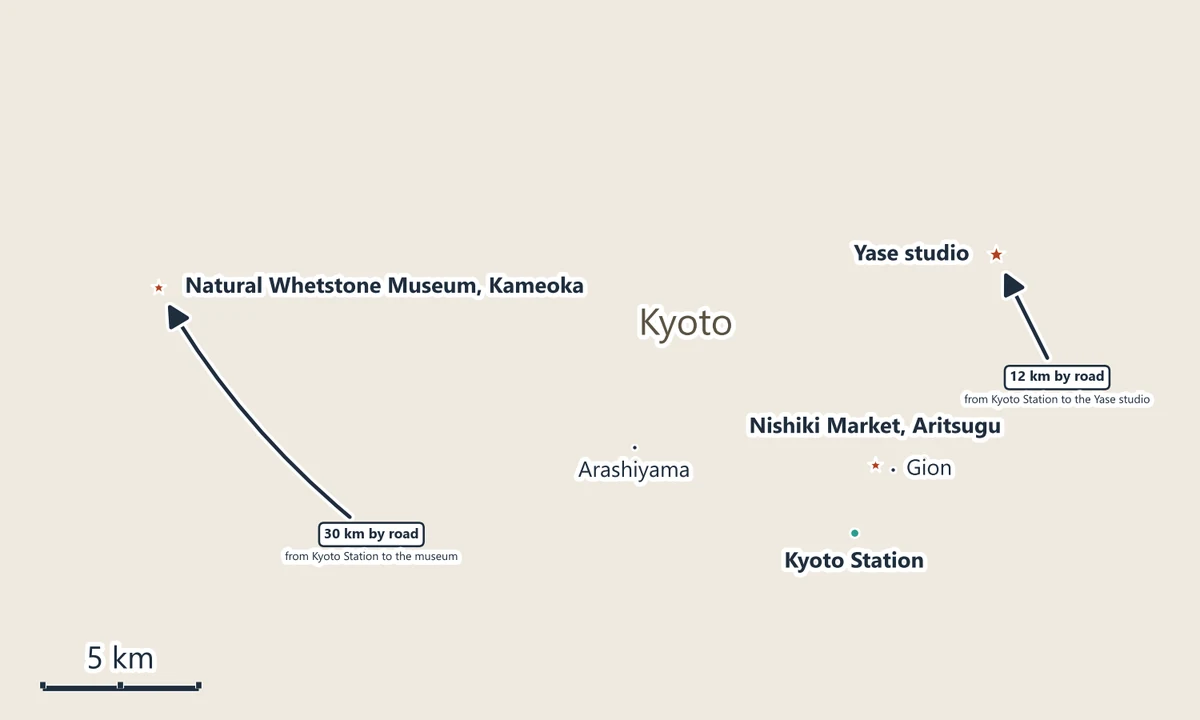
The workshop runs at two studios in Sakyo Ward with the same facilities and the same programme. Unless you are told otherwise, you go to Studio NIN Yase, 168-1 Yase-no-secho, Sakyo-ku, Kyoto, one minute on foot from Yase-Hieizan station (Eizan Railway); depending on bookings, your session may move to Studio NIN Kendo, and staff message you before your visit to confirm which. The exact meeting place is the one confirmed after booking. Yase is about 12 km by road from Kyoto Station.
When your date is full, the second studio is sold as a listing of its own: Kyoto: Japanese Knife Forging Workshop at Studio NIN Kendo, the same three hours for up to 8 guests, at 16 Shugakuin Daido-cho, Sakyo Ward: 17 minutes on foot from Shugakuin Station (Eizan Railway), close to Shugakuin Imperial Villa. It was per person from $164 (checked November 2026).
Who can join
On children the workshop contradicts itself: children under 15 are listed as not suitable, and a separate note says children under 15 should be accompanied and protected by adults. If anyone in your party is under 15, check with the operator through GetYourGuide before you book, not on the day. People over 95 are listed as not suitable. Instruction is in English or Japanese.
When a sharpening class is the better buy
A forging workshop teaches you how a blade is born; it does not make you good at keeping one sharp. If that is what you want to take home, the one-hour classes do it better. Japanese knife shop HIRAI's workshop pairs sharpening with fitting a magnolia handle in a group of 3 at most; 縁-en-'s class spends its hour on whetstones and ends with a before-and-after sharpness test; the personalised workshop sold as "Kyoto Gion", which meets in Pontocho, adds your name engraved on the wooden handle. Japanese Knife Sharpening's 2-hour class at MUSASHI JAPAN's Kyoto flagship starts at $97 for its Standard Plan. You take home the knife you sharpened; the options separate a Standard Plan from a With Gift Knife plan, so check which one you book (checked November 2026). One whetstone lesson is booked directly instead: the Natural Whetstone Museum in Kameoka runs a JPY 3,000 sharpening workshop on its own booking system (the museum guide has the fees and the bus times).
Buying a knife in Kyoto
The knife shop on the Nishiki Market street, in the city centre, is Aritsugu: open 10:00 to 17:00, with new sales until 16:30, and closed on Wednesdays (its own site, checked November 2026). Nishiki Market has no market-wide closing day, but many of its shops close on Wednesday too. Kyoto knife shops has the walk from Gion-Shijo Station, Aritsugu’s sharpening service and the other names you will hear.
Kyoto, Sakai or Tokyo?
Kyoto is where the forging workshop is; Sakai, south of central Osaka, and Tokyo have knife workshops and shops of their own. Choose by where your nights are booked and by what you want your hands to do. Kyoto, Sakai or Tokyo for knife making compares the three.
Getting your knife home
A knife cannot travel in the aircraft cabin out of Japan: Japan’s transport ministry bans bladed items from the cabin, so the knife goes in your checked bag, and you check your airline’s own rules before you fly. On the way to the airport, keep it wrapped, as the box it comes in does. Taking a Japanese knife home quotes the rules for Japan and the US.
Three Hours at the Forge, a Knife to Take Home
Kendo Experience's forging workshop in Sakyo Ward: raw iron heated in a furnace, hammered into a blade, then sharpened and polished into a knife of about 13 to 15 cm. Instruction in English or Japanese. Free cancellation up to 24 hours before. Starting from $151 per person.
See datesMore Hands-On Kyoto
Kyoto Workshops and Experiences with Open Dates
Workshops and experiences in Kyoto with live availability. What is included and the cancellation terms are on each listing.
Kyoto Knife Making: Questions
Where to make a knife in Kyoto, how long it takes and what it costs, children, sharpening classes, buying a knife and flying home with one.
At a blacksmith's studio in Sakyo Ward, in the north-east of the city. Kendo Experience's forging workshop runs at Studio NIN Yase, a minute's walk from the nearest station, or at Studio NIN Kendo when bookings send you there; staff message you before your visit to confirm which. It is the one workshop in Kyoto where the blade starts as raw iron. The other knife workshops sharpen, fit or finish a ready-made blade: see Kyoto knife making class.
Three hours for the forging workshop. That covers blacksmith clothes, the tools and safety, heating the iron in the furnace, hammering the blade, then sharpening and polishing. The sharpening and handle-fitting classes take 1 hour, or 1 to 2 hours at Japanese knife shop HIRAI.
The forging workshop was from $151 per person, checked November 2026. Sharpening classes start lower: Viyago Japan's Arashiyama workshop costs less, though which plan its from-price buys is not stated, and the from-price is a date-specific discounted price; read the option before you book. A wooden handle on the forged knife is an upgrade that costs extra.
Yes: the forged knife, about 13 to 15 cm long, goes home with you in a box with a bag. A wooden handle is an upgrade that costs extra. The sharpening and handle-fitting workshops of Viyago Japan, HIRAI and the personalised workshop that meets in Pontocho also send a knife home with you; 縁-en-'s sharpening class is not stated to send one home.
Check before you book: the workshop contradicts itself on children. Children under 15 are listed as not suitable, and a separate note says children under 15 should be accompanied and protected by adults. Ask the operator through GetYourGuide before booking anyone under 15. HIRAI's workshop is not suitable for children under 12, and the Arashiyama workshop does not take children under 6.
Yes, in the arms. Reviews from late October and early November 2026 describe the hammering as hard physical effort. The instructors stay beside you, and some of the work involves danger: the customer is responsible in the unlikely event of an injury or accident.
Forging if you want to make the knife; sharpening if you want a skill to use at home. The forging workshop shows how a blade is made in three hours; a one-hour class teaches the angles and strokes you will repeat on your own knives. See Kyoto knife sharpening class for the classes side by side.
Yes: Aritsugu, the knife shop on the Nishiki Market street, is in the city centre. It is open 10:00 to 17:00, with new sales until 16:30, and closed on Wednesdays, 1 to 4 January and 31 January (its own site, checked November 2026). Nishiki Market lists Aritsugu as its one cooking-gear shop. See Kyoto knife shops.
No. Japan's Ministry of Land, Infrastructure, Transport and Tourism bans all bladed items from the aircraft cabin, and in the US the TSA allows knives in checked bags only, sheathed or securely wrapped. Pack the knife in your checked bag and check your airline's own rules. See taking a Japanese knife home.
In Kameoka, west of Kyoto, not in Kyoto city. Entry is free; it opens 10:00 to 16:00 and is closed Monday to Wednesday and over the New Year. Its sharpening workshop is JPY 3,000 per person, fees as revised on 22 October 2026. The way in is the JR Sagano Line to Chiyokawa, about 20 minutes from Kyoto Station, then a short bus ride: see the whetstone museum guide.
Kyoto for forging a knife from iron; Sakai, near Osaka, and Tokyo if that is where your nights are. Both have workshops and knife shops of their own. See Kyoto, Sakai or Tokyo for knife making.
Still have questions? Email us at info@kyotoknifemaking.com